


The route to improvement
Planning where and how the wheels on the bus go round and round isn’t a guessing game; it’s the intersection of facts and feedback. We take a behind the scenes look at how this happens.
Headphones on, seat near the back, watching the world go by. That’s how Oliver Haycock enjoys bus route 62 to and from the Bay of Plenty Regional Council office in the Tauranga CBD. With a busy work life, the 20-minute ride is his way to unwind at the end of the day – and get a sense of how the services his team have designed are working.
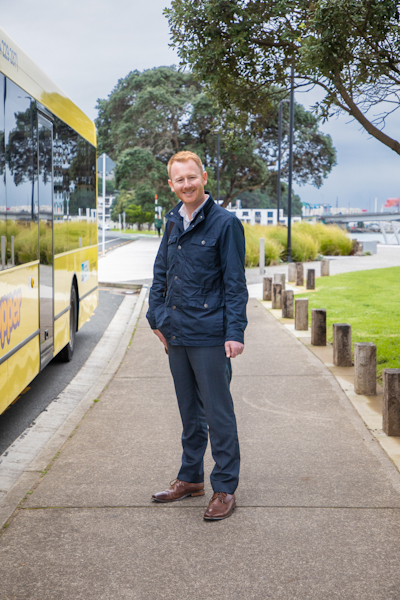
When you’re the director of public transport for the Regional Council, you could assume there is an obligation to use the service you advocate for, but Oliver (Ollie for short) says it’s more than that.
“Part of it is about understanding the service we offer and how it’s operating, but a big part of it is that it’s an opportunity to sit back and relax. With a busy work life, that time on the bus is really valuable.”
That life includes helping the Regional Council design and deliver a bus system that’s safe, reliable and inclusive – now and into the future. That comes in two forms: long-term strategy, to look at what regional transport could look like up to 30 years into the future, and short-term operations, to deliver day-to-day bus services that are fit for purpose.
While many of us spend time thinking, feeling or having opinions about transport, Ollie’s made a career out of understanding the ‘science’ of public transport systems and the influence they have on the way people move, live and connect.
Originally pursuing a degree in geology, a summer job processing bus pass applications for a bus company in Birmingham, UK, became the catalyst for changing his career trajectory.
With an interest in data and analytics, Ollie spent late nights writing code and streamlining processes, to improve how the applications were processed and delivered for the benefit of both the staff and the customers.
He’s now armed with a degree in transport planning and more than 15 years’ experience, but the drive to pair data and real-world experiences to inform people-led decisions hasn’t changed.
“Public transport is something that’s maturing at an almost exponential rate within the Bay of Plenty, and with the change in maturity of the service outside the building, there’s also been an evolution in how we deliver the service internally.
“We’ve got a fair few years of data and analytics to help build our understanding of what works and what doesn’t, and where we can deliver the most benefits. We then knit that together with customer feedback to deliver improvements that communities want to see.”
The data speaks for itself when it comes to painting a picture of just how many people are using buses to get from A to B. On its busiest day, the Baybus network sees more than 12,000 boardings across the region, with a record-breaking 3.4 million trips made last year alone.
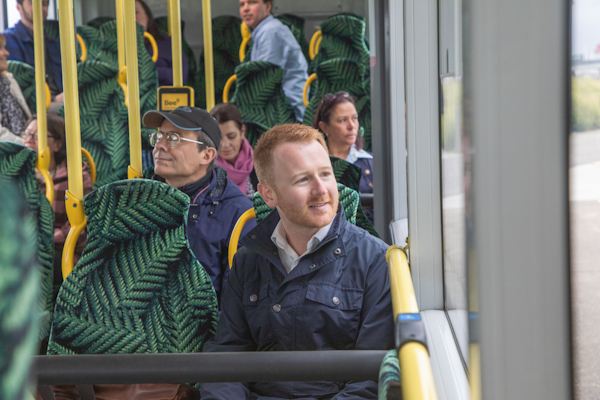
Numbers aside, for Ollie and his team, public transport is more than people on buses – what it really comes down to is access and equity.
“It’s a public good, like education or healthcare, because, when it works well it, it opens doors to helping improve so many other parts of our society – for example, it strengthens community hubs, supports economic growth, helps revitalise city centres, and reduces emissions.
“One of the biggest misconceptions is that we’re trying to ‘force’ people out of cars and on to buses, but we know that public transport isn’t going to work for everyone. What we’re trying to do is give people a choice, by making our services as good as they possibly can be, by meeting the needs of as many different people as possible.”
As someone that experiences the bus service regularly, Ollie is the first to admit public transport isn’t perfect – but he also says the ‘nirvana’ of perfection isn’t achievable. It’s just the nature of an industry that must continually adapt to what people need to live, work and play.
“Public transport requires continuous improvement; there will never be a day when the work is done. I worked for the best part of a decade in London, which has arguably one of the best public transport networks in the world, but I spent many years on projects to improve things here and there. You’re always looking for ways to shave 10 seconds off a journey or get better value for money.”
“Here in the Bay of Plenty, we’re experiencing very rapid growth and public transport has to scale with this. That’s why the Regional Council works very closely with our colleagues at city and district councils, as well as at NZ Transport Agency, to make sure the service and the infrastructure that our communities need as part of this growth go hand-in-hand.”
In the three-and-a-half years that Ollie has been with the Regional Council, there’s been a huge number of changes to the public transport space – from national-level challenges, such as driver shortages, changing travel patterns post-Covid, and financial pressures, to a greater emphasis on digital integration and the trial of on-demand services.
Despite this, the fast-paced, customer-facing nature of his role means his passion for public transport remains constant.
“There are so many heartwarming stories. I’ve spoken to parents whose teens have gained real independence through the bus network, and Total Mobility users about how the service keeps them connected to their local community.”
“What I love most about this role is that you have a connection to bus users. You get a very holistic exposure to transport in the community and can see and feel first-hand how you can help make a tangible difference in people’s lives in the place where you live.”