


Wallaby elimination operation success
An aerial pest control operation in Endean Forest, near Rotorua, has successfully eliminated wallabies from the site.
Tipu Mātoro Central North Island Programme Lead, Davor Bejakovich, says preventing wallabies from spreading further west was a crucial objective for the team.
“Wallabies were first released near the Rotorua Lakes area in 1912 and have since become established across 200,000ha in the region.
“They graze pasture, browse native plants and seedlings, damage young commercial trees, and reduce biodiversity across productive farmland, forests, and iconic landscapes.
“It’s been estimated that if no control work is undertaken, a third of the North Island could be impacted by the spread of wallabies within 50 years. That’s a motivating reason to act now and to stop their spread.”
The Tipu Mātoro programme’s success relies on first preventing their spread from areas where they are already established, which is known as the wallaby Containment Area. Endean Forest lies just outside the Wallaby Containment Area, making it a priority zone for stopping their westward movement.
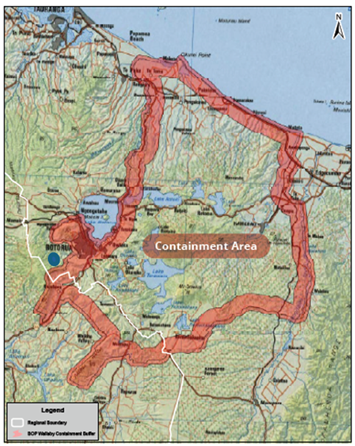
Above: Endean Forest, highlighted in dark blue, to the lower left of urban Rotorua. Credit Bay of Plenty Regional Council GIS
Prior to the control operation, camera monitoring has been operating for two years in the area. The monitoring revealed that wallabies were primarily confined to the pine plantation within the forest, with only one or two sightings in neighbouring native bush. This key information helped refine the final design of an aerial baiting operation, which was completed in August 2025.
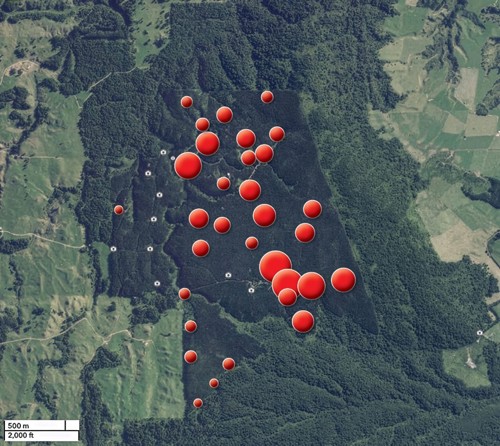
BEFORE Control - the red dots represent trail cameras that recorded wallaby interactions (a wallaby passing by), with the size of the dot relative to the number of interactions.
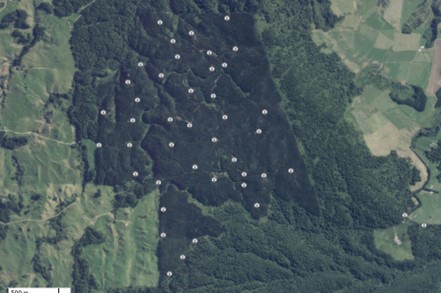
AFTER Control – the grey dots indicate where a camera was in place, but no wallabies were recorded.
The operation covered 570ha and included 330ha of privately-owned pine forest and a buffer of surrounding public conservation land (PCL).
Bait containing sodium fluoroacetate (1080) is the most effective tools to control wallabies at scale. Its distribution by helicopter meant that all wallaby had equal access to the bait, dramatically improving the chances of successful control.
Helicopters distributing the bait in the operational areas followed pre-set, GPS-monitored flight paths to ensure targeted distribution, as well as live tracking of the flight paths.
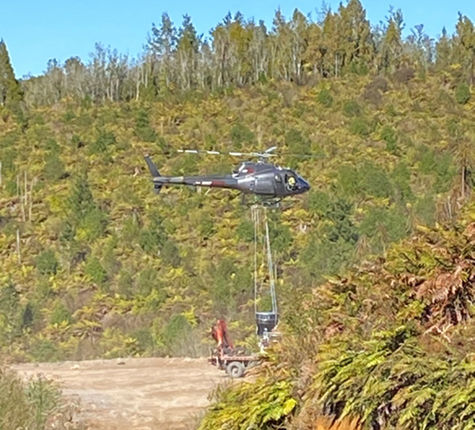
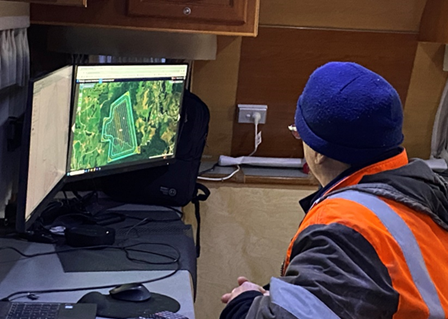
Above: Live monitoring of the aerial bait operation from a nearby caravan to ensure highest possible distribution accuracy. Credit Dale Williams
Nearly six months after the operation, no wallabies have been detected on any of the surveillance cameras set up in the forest and surrounding area.
“The monitoring results give us real confidence that wallabies are no longer present in Endean Forest,” says Mr Bejakovich. While this is a big win for the programme and local communities, our focus now is making sure the area isn’t reinfested.”
To prevent wallabies from crossing Ngongotahā Stream and re-establishing in the forest, ongoing surveillance in the surrounding area is underway. This involves camera monitoring, dog teams and ground night‑shooting around the lower slopes of Ngongotahā Maunga.
Background Information
Agencies using 1080 must comply with strict regulations to ensure public safety. These regulations are administered by the Ministry of Health and WorkSafe.
Operations begin with the distribution of non-toxic pre-feed bait to prepare the target species to eat the toxic bait that will be applied, ideally 7 to 10 days afterwards.
Learn more about why 1080 is used to control introduced pest animals