
Skip to main content Skip to footer
Menu
oset system oset system

Maintaining your wastewater system

If your property is not connected to the wastewater network, you will have an on-site wastewater system. As a property owner, you are responsible for maintaining your on-site wastewater system and knowing how it works.

Maintaining a septic tank

Septic tanks are an underground system that treats wastewater from your toilet, kitchen, bathroom and laundry.

Septic tanks separate wastewater into three layers:

  • Sludge (solids) settle at the bottom
  • Scum (fats and oils) float to the top
  • Liquid flows out to a soakage (land application) area.

Maintenance and pump-outs

Regular maintenance is essential to keep your system operating correctly and as intended. safely.

  • Septic tank must be inspected by a suitably qualified and experienced person, and pumped out when required, with septage taken to an approved disposal facility.
  • Tanks should be pumped out every 3–5 years (or every 3 years in maintenance zones), or when the sludge and scum levels exceed one-third of the tank capacity.
  • Smaller tanks or larger households may need more frequent pump outs
  • Clean outlet filters regularly.
  • Keep tank lids accessible for inspection, servicing and pump outs.

Looking after your system

Simple steps can help your septic tank last longer and avoid problems:

  • Use water efficiently and fix leaks
  • Keep stormwater out of the system
  • Do not drive or build on the soakage area
  • Only flush toilet paper and human waste
  • Avoid putting wipes, sanitary items, fats, oils or chemicals down the drain.

Signs of problems

Contact a suitably qualified and experienced person   if you notice:

  • Wet or boggy ground,
  • Sewage smells
  • Slow drains or backups

Maintaining an Aerated Wastewater Treatment System (AWTS)

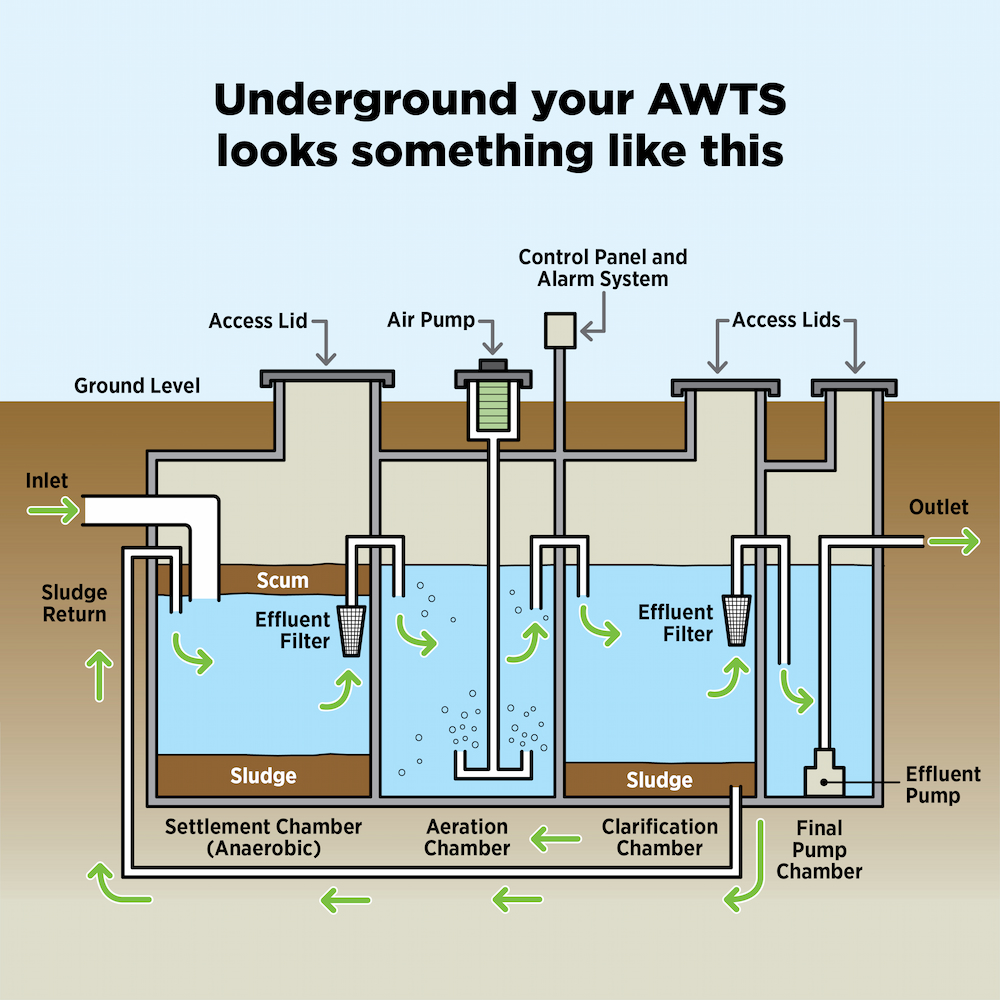
Generally, an AWTS is a system of underground tanks, filters and a blower, with only the access lids usually visible above ground. The system provides secondary treatment, which improves the quality of wastewater before it is discharged to land.  

To operate correctly and as intended, , your AWTS needs regular maintenance by a trained technician every 6 to 12 months depending on the manufacturer’s requirements.

If your system is not maintained and doesn’t work properly, it may cause odours, overflows or ponding of wastewater, health risks to your family or environmental contamination.

Graphic of AWTS

What you need to do

  • Keep your operating instructions and the suppliers name and number on hand.
  • Make sure the system is serviced by a suitably qualified and experienced person at the manufacturer’s required intervals, usually every six to twelve months. Request a service report and promptly address any issues or concerns identified.
  • If you sell your property, pass these details on to the next owner. Call the service agent as soon as the alarm is activated. The issue will not resolve itself and only get worse and more expensive to fix.
  • Call the service agent if there are odours, overflows or ponding on the land application area.
  • Make sure the system is accessible for inspection and servicing, including access lids and control panels.
  • Care for the land application area by regularly mowing the grass or maintaining the planting and mulch. Make sure all the driplines are covered.
  • Do not cover any part of the land application area with buildings, paving, concrete or other structures. 
  • Do not drive over the land application area or allow stock to access it.

Regular servicing helps keep your system operating correctly and as intended, and is a requirement in the rules.

 During a service, the technician will check and maintain parts of the system such as:

  • Check electrical components and alarms
  • Clean filters and  blowers
  • Pump and float system
  • Assess sludge and scum levels, and notify you if a pump out by an approved contractor is required.
  • Flush  driplines or LPED system (where applicable).
  • Performance and condition of the land application system.

You should request a copy of the service report after each visit and promptly address any faults, repairs or maintenance issues identified.

Most AWTS for residential homes are installed as a permitted activity, meaning no resource consent is needed if all conditions are met (including regular maintenance). A well-maintained system is considered low risk to the environment.

If your system is not maintained, it may no longer meet the permitted activity requirements. This means:

  • You may need to apply for a resource consent
  • There is a cost to apply, plus ongoing monitoring fees
  • The consent will include conditions requiring the system to be operated and maintained correctly to ensure the system  does not cause a nuisance or environmental harm.

Regular servicing helps you avoid these extra costs and requirements.

Do:

  • Use water wisely
  • Scrape food off dishes
  • Keep access to system lids clear

Don’t:

  • Flush anything except toilet paper and human waste
  • Use a waste disposal
  • Put wipes, nappies, chemicals, or paint down drains
  • Allow vehicles, stock, or deep-rooted plants over the soakage area

For more information phone 0800 884 880 or visit www.boprc.govt.nz/oset